


Horizon
Make the laws of physics work in your business!
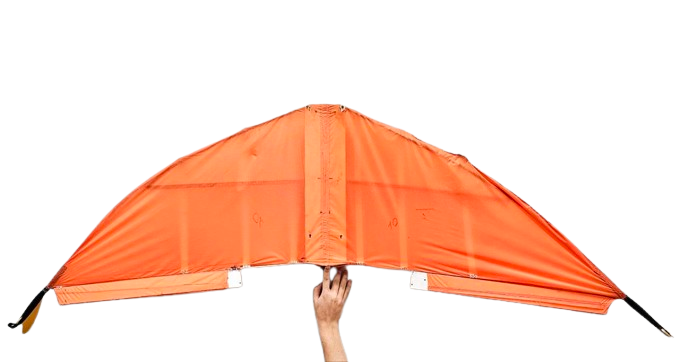
The research wing was developed by our laboratory's specialists to address key challenges, including reducing the cost of equipment needed for data collection in areas such as agriculture, geological exploration, and others.
This compact (fits into a 15x120 cm diameter tube), lightweight, and cost-effective solution can carry up to 2.5 kg of payload for six hours at speeds up to 120 km/h.
We are ready to adapt the wing and nacelle design to your operating conditions and develop specialized drone control algorithms to address your specific application needs.
Horizon in action
Collection of scientific data
The Horizon Wing is a robust, high-performance platform designed to enable autonomous data collection in the most inaccessible and remote areas of the planet, where traditional methods are too expensive or dangerous. Its flight range of up to 300 km enables research over vast and previously inaccessible territories, such as mountain ranges, polar zones, and oceanic expanses.
A payload capacity of up to 2.5 kg enables the flexible integration of specialized scientific modules, including sophisticated multi- and hyperspectral sensors, atmospheric samplers, and population monitoring equipment. The drone guarantees trajectory repeatability and data georeferencing, which is critical for long-term research. Thus, the Horizon Wing is a tool that empowers scientists to transcend limitations and obtain the precise data needed for breakthrough discoveries.
| Проблема | Решение | Ценность |
| Ограниченная доступность территорий | Сверхдальняя Логистика: дальность до 300 км позволяет проводить исследования над удаленными, опасными (вулканы) или недоступными (Арктика, обширные леса) областями. | Расширение географии исследований: получение данных, которые ранее можно было собрать только с помощью дорогостоящей пилотируемой авиации или многомесячных экспедиций. |
| Низкая частота и объективность сбора данных | Автономный и повторяемый мониторинг: дрон гарантирует точное повторение траектории полета для сбора данных в одной и той же точке в разные временные промежутки. | Высокая достоверность данных: обеспечение строгой повторяемости и объективности измерений, что критически важно для построения долгосрочных научных моделей. |
| Высокие операционные расходы | Экономичная платформа: использование БПЛА для размещения датчиков вместо пилотируемой авиации или найма многочисленных экспедиционных групп. | Снижение бюджета исследований: уменьшение затрат на логистику, топливо и обеспечение безопасности персонала, позволяя направить больше средств на анализ данных. |
Key functional benefits:
The Horizon Wing's primary functional advantage is its ultra-long-range autonomous mission. The drone can fly up to 300 km from its launch site, enabling efficient logistics and large-scale monitoring in the most remote regions without the need for intermediate bases. This dramatically reduces operating costs and response times in critical situations.
Furthermore, the drone boasts a versatile payload (up to 2.5 kg) and a flexible integration platform. This feature enables a wide range of applications, from transporting medicines and mail to deploying professional multispectral sensors for scientific research and agricultural monitoring. Technological Readiness Level 7 (TRL 7) (tested in real-world conditions) guarantees high reliability and optimized operating costs thanks to the efficiency of its fixed-wing design.
Want to know more?
Tell us about your business region, the crops you cultivate, and the tasks you plan to solve with our wing, and we'll contact you as soon as possible.
Questions and Answers (FAQ)
1. What scientific equipment can be integrated, given the payload limit?
Answer: The Horizon Wing supports a payload of up to 2.5 kg. This is sufficient for integrating high-precision yet compact scientific modules: multi- and hyperspectral cameras, meteorological sensors, gas analyzers (atmospheric samplers), or specialized laser scanners (Lidar), which are necessary for detailed mapping and data collection.
2. How is the accuracy and repeatability of data collection ensured over long distances?
Answer: Trajectory repeatability and data accuracy are guaranteed by using a professional autopilot system and, if necessary, integrating RTK/PPK technology for centimeter-level georeferencing. This allows for monitoring the same point over long periods (seasonal monitoring, studying process dynamics).
3. Where (geographically) can the drone conduct research?
Answer: With a range of up to 300 km and reliability, the Horizon Wing is ideal for research in hard-to-reach and remote areas (polar regions, high mountains, vast forested areas, coastal and marine areas). The drone allows for the collection of critical data in areas where manned aircraft or ground expeditions are impossible or economically unfeasible.