


Horizon
Make the laws of physics work for your business!
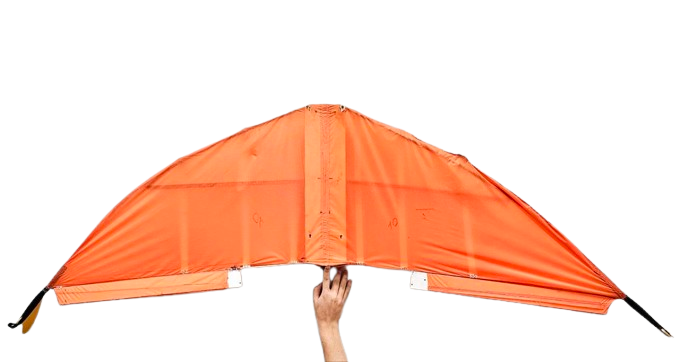
The research wing was developed by our laboratory's specialists to address key challenges, including reducing the cost of equipment needed for data collection in areas such as agriculture, geological exploration, and others.
This compact (fits into a 15x120 cm diameter tube), lightweight, and cost-effective solution can carry up to 2.5 kg of payload for six hours at speeds up to 120 km/h.
We are ready to adapt the wing and nacelle design to your operating conditions and develop specialized drone control algorithms to address your specific application needs.
Horizon in action
Agriculture
The Horizon Wing is a high-performance unmanned aerial vehicle designed to optimize agricultural processes in large agricultural holdings.
With an operating range of up to 300 km, the device enables efficient data collection over large areas, surpassing the limitations of traditional solutions.
| Problem | Solution | Value |
| Delayed Detection | AI analytics and multispectral cameras: Automatic detection of diseases (up to 95% accuracy) and plant stress (NDVI) at early stages. | Prevention of crop losses and reduction in the risk of disease spread to neighboring plots. |
| Excessive Resource Consumption | High detail and georeferencing: Drones create precise maps, showing exactly where (down to the square meter) water, fertilizer, or chemicals are needed. | Resource savings of 60-80%, significantly reducing the cost of production (COEH). |
| High Labor Intensity | Autonomous Monitoring: Drones cover thousands of hectares faster and more affordably (only $10-$20 per hectare in developed countries). | Optimization of personnel and reduced dependence on labor shortages compared to manual inspection ($50-$100 per hectare). |
Key functional benefits:
Resource management: Using UAVs to obtain multispectral data enables the targeted application of crop protection products and fertilizers, reducing operating costs by up to 70%.
Risk reduction: The system ensures timely diagnosis of plant stress and diseases, minimizing potential crop losses.
Scalability and efficiency: Fast and autonomous monitoring of thousands of hectares provides farm managers with objective data for informed strategic decisions.
Using a "horizon" wing is essential for achieving maximum profitability and compliance with precision farming standards.
Want to know more?
Tell us about your business region, the crops you cultivate, and the tasks you plan to solve with our wing, and we'll contact you as soon as possible.
Questions and Answers (FAQ)
How many hectares can a single Horizon wing cover in a working day?
The Horizon wing can cover 1,200 to 2,000 hectares in a single 8-hour shift (assuming two full flight cycles) with the high level of detail necessary for precise agricultural monitoring.
How accurately does the data match manual inspection?
A drone doesn't completely replace an agronomist's expertise, but it dramatically improves their efficiency. A drone takes over the routine, large-scale work of collecting objective, geo-referenced data, allowing the agronomist to:
- Know exactly where to go: Instead of wandering across the entire field, the agronomist is directed only to those small areas that AI analytics has flagged as problematic.
- Save time: Using AI analytics to automatically classify problems (e.g., 95% accuracy in weed detection).
Thus, the accuracy of data obtained from a drone is higher than that of manual inspection in terms of scale and timeliness of diagnostics.
Is certification required before using the Horizont wing?
Since your drone has an operating range of up to 300 km, its operation will always be classified as a flight beyond the operator's visual line of sight (BVLOS). BVLOS flights in Europe and other target jurisdictions require a special permit under the "Specific" category (EASA) after a successful risk assessment (SORA). Without this permit, you will not be able to legally use the drone's key advantage (range) over vast agricultural areas.